

Risk Management · 2025
In this section3 topics
Risk Management Policy & Plan
Policy & Plan Description
nForce Secure Public Company Limited realizes the importance of enterprise risk management in the management system and operations with the aim of making risk management a corporate culture. All employees must apply the policy appropriately and realize the importance of sustainable risk management. In addition to helping the company to be able to operate the business to achieve the main objectives and goals set, including having good corporate governance, it also creates a concrete added value for the Company. Therefore, in order for various departments in the Company to have a risk management approach in the same direction, the Executive Committee therefore formulates the Company's risk management policy. This edition is intended to serve as a guideline and framework for operational risk management for all employees. This will lead to the achievement of risk management objectives throughout the organization and the maximum benefit to the Company in the future. The overview of the risk management policy of the Company is as follows:
The Company’s Risk Management Framework
At the organizational level:
including the Executive Committee, under the policy and supervision of the Board of Directors, where the Chairman of the Executive Committee is the chairman whose duties and responsibilities are in accordance with the Company's guidelines. As well as the internal control system is reviewed by the Audit Committee.
At the departmental level:
department manager and all internal employees (Risk Management Working Group) under the supervision of the Executive Committee.
Roles, Duties, and Responsibilities in Risk Management
Risk management is the duty of the Company’s employees at all levels, including those acting as consultants, person acting on behalf of the Company. The roles and responsibilities are as follows:
The Risk Management Committee
Develop a risk management policy in regards to overall risk management which covers main risks that are consistent with the entity's objectives, key goals, strategies, and acceptable risks as a framework for the operation of the risk management process for everyone in the organization to be in the same direction to propose to the Board of Directors for consideration by supervising the Company and its subsidiaries to have risk identificationsby considering both external and internal factors that may cause the Company and its subsidiaries to fail to achieve the stated objectives.
Establish the Company's risk management strategy and guidelines in accordance with the risk management policy so that each type of risk can be assessed, monitored, and controlled at an appropriate level by engaging various entities in risk management and control.
Maintain and monitor compliance with risk management policies under guidelines and procedures approved by the Board of Directors By focusing on the process of the Company's risk assessment, Monitoring, and communication.
Supervise the Company to prevent and monitor the emerging risks that may ensue.
Review the adequacy of the policy, the Company's risk management system, and subsidiaries, including the effectiveness of the system and compliance with specified policies.
Give suggestions to the Company for review of the risk management framework at least once a year to ensure that the framework is still consistent and suitable for the Company's operations and the process of risk management of the Company.
Give suggestions on matters that require improvements to implement according to the risk management process, including consulting recommendations to the company in risk management operations with the policy and strategies set by the Board of Directors.
Review the Company's risk management reports to ensure that the organization has adequate and appropriate risk management.
Authorize to appoint and assign specialized personnel and/or insufficient knowledge and expertise to consult on the company's risk management process and assessment to achieve its objectives within the specified timeframe.
Provide opinions and suggestions in cases where the Company has a need to outsource some of its functions where the Company has specialized personnel and/or insufficient knowledge and expertise to perform duties in order to achieve the planned results. However, such employment shall be from time to time only.
Supervise the subsidiaries (if any) to comply with the Company's risk management policy, including operating under the Company's risk management framework.
Communicate and exchange information and coordinate the risks and internal control with the Audit Committee at least once a year.
Risk Management Working Group
The Risk Management Working Group will be responsible for implementing the risk management guidelines to prepare the relevant risk mitigation plans. Implement and report the results of the implementation of the plan to the secretary of the Executive Committee on time. Under the supervision of the Executive Committe Each party must perform the following actions: Identifying various risks and analyzing and assessing potential risks, including the likely impact on the Company.
Prepare a risk management plan in the responsible line in order to include the risk management system as part of the work process as well as communicate and convey it to the operators in the line to acknowledge and practice properly, to ensure that risks are assessed, managed, and reported on in practices properly.
Examine, review, and assess potential risks, including the trend of impacts that external and internal risks may have on the organization.
Determine risk management policies, guidelines, and risk management processes for submission to the Executive Committee for consideration of the overall risk management plan.
Determine the risk management strategies and resources used by the Company in accordance with the risk management policy, as well as the Company's strategy and business direction.
Report on the results of risk management and risk management, including the risk status of each specified topic, to the Executive Committee for consideration every quarter.
The Audit Committee
Examining the performance of the internal audit department and auditors and creating reports as required by external regulators as well as reviewing the adequacy and efficiency of risk management of the Company and its subsidiaries to ensure that the Company's operations and information disclosure are transparent and reliable.
Internal Auditor
Communicate with management and auditors about risks to plan an audit that focuses on risk (Risk-Based Auditing).
Ensure that the Company has sufficient and appropriate internal controls for risk management and that controls are effectively followed.
Risk Management Policy
Risk management is the process of dealing with risks in the operations of the Company according to the goals that have been set by providing a system and a plan for risk management. In order to manage the risks affecting the Company, the level and size of the impacts to be at an acceptable level, including systematic assessment, control, and audit, by taking into account the achievement of the Company's goals as a priority.
The Company's risk management process
The Company's risk management process, which follows the risk management guidelines of The Committee of Sponsoring Organizations of the Treadway Commission (COSO), consists of 6 steps as follows:
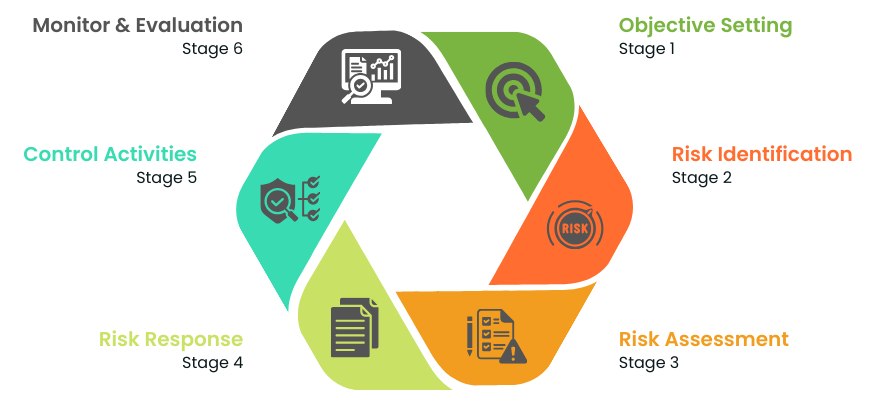
Stage 1 Objective Setting
Establish business objectives or the purpose of the work that makes it clear that it is consistent with policies, goals, strategies, and acceptable risks in order to be able to analyze the expected risks in their entirety in all departments. This will lead to good risk management at the department level.
Stage 2 Risk Identification
Risk Identification is to find out what risks are likely to occur and prevent agencies and organizations from achieving their objectives. Risk classification can be divided into 4 categories as 1) Strategic Risk 2) Operational Risk 3) Financial Risk 4) Compliance Risk and 5) Sustainability Risk
Stage 3 Risk Assessment
Stage 4 Risk Response
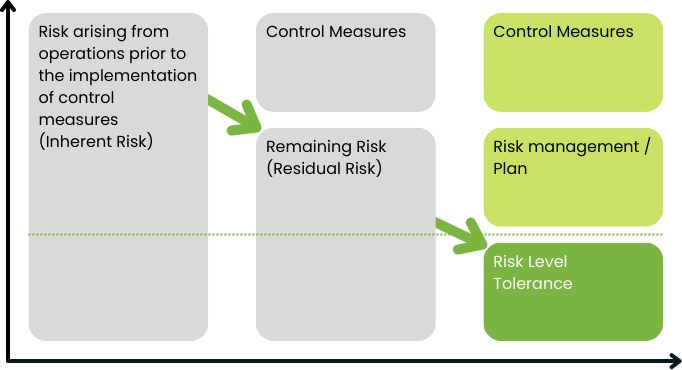
Risk response entails determining operational guidelines to reduce the likelihood of loss by using the results of the risk assessment from step 3 to develop a risk management plan. The agency that owns the risk understands the risks that are most relevant to their departments and manages risk management plans by analyzing how to manage the expected risks. One or a combination of methods to reduce the risk of occurrence and/or reduce the severity of the risks' impact to an acceptable level, as well as manage risk management plan for the unit itself.
Stage 5 Control Activities
Control activities are policies and operational guidelines for control established by management to ensure that an effective risk management/management plan is clearly defined for those responsible and the timing of implementation. And that control activity is one of the methods of risk management/ management plan.
Stage 6 Monitoring & Evaluation
Monitoring and evaluation refer to the processes of performance quality control, and evaluation of additional risk management/management plans or control activities are implemented continually and consistently by following up during the operation and evaluating it from time to time to ensure efficient and effective management/plan. Therefore, progress, problems, and obstacles to risk management/management plan must be reported to be used as a guideline for further review or improvement of risk management/management plans.
In 2025, the Risk Management Committee regularly monitored the implementation of various risk management measures and reviewed the results of the Company’s risk assessment every six months. Additionally, the Committee provided recommendations and/or suggestions to the Risk Management Working Group to reconsider and adjust their operational strategies to align with the Company’s business plans and the current economic situation.
Policy Document Link
https://image.makewebeasy.net/makeweb/0/heIKBxdjr/Document/Policy_Risk_Management_EN.pdf?v=202405291424
Risks to the Company's Business Operations
Risk Register
| Risk Name | Risk Characteristics | Consequences | Management Measures | Related Risk Factors |
|---|---|---|---|---|
| The risk of dependence on vendors | The Company operates as a distributor of cyber security products and related network management products from world-renowned vendors, wherein all the vendors that are distributors are leaders in cybersecurity in areas such as firewalls, anti-virus, and anti-malware software, authentication, and encryption, etc. There are also services related to the products that the Company provides to customers who use various products, such as training services for the use of the system, installation services, and maintenance services, including consulting services for various problems caused by the use of the system or software that the Company sells as a distributor, etc. The Company has made purchases of goods and services from product owners where the purchase proportion exceeds 30% compared to the total value of all goods and services purchased by the Company. In 2025, there was one such supplier, Palo Alto Networks, Inc. (“Palo Alto”). The Company's purchases of goods and services from Palo Alto accounted for 70.36% of the total value of all purchases, while revenue from selling Palo Alto products and services represented 70.49% of the Company’s total sales and service revenue. | This reliance on a single supplier may have a significant impact on the Company’s operational performance if Palo Alto decides not to renew the distributorship agreement or is unable to supply products within the required timeframe. Additionally, if the Company fails to secure alternative products to replace Palo Alto’s offerings, it could further affect business continuity. However, the Company has maintained a positive and long-standing relationship with Palo Alto, having been a distributor of their products for over 10 years. Given this established relationship, the Company is confident that it will be able to continue renewing its agreement with Palo Alto. Palo Alto is a globally recognized company specializing in hardware and software security solutions. The Company is confident that Palo Alto will continue to provide high-quality products that meet the needs and expectations of its customers and end-users. | The Company focuses on selecting products that are well-known as well as having a unique point of various products to promote the diversity of technology and as alternatives to the contractors and system integrators (SI) and effectively meet the needs of end users. The products that the Company chooses to be a reseller of are different in terms of technicality. The products that the Company selects for sale are not causing any competition or to compete in the market share between the products that are the distributors themselves, causing the company to gain the trust of various product owners. As a result, there is a diversification of the risk of relying on a single large product owner. | 735 · Description: Reliance on large partners / distributors or few partners / distributors · Info category: STRATEGIC_RISK |
| The risk of failure to comply with the terms and conditions of the vendors’ contract | The Company is a distributor of cyber security products. Many leading vendors place orders with the Company with the agreement to appoint distributors for the main products manufactured by the Company. Distribution contracts have an average contract term of 1 - 2 years, and most of them can automatically renew the contract to appoint dealers if the Company can comply with the terms and conditions. The Company must also comply with the reseller contract established by each vendor. Each vendor has terms and conditions that the Company must comply with under different contracts, such as performance requirements, marketing or recommending products, requirements relating to the training of employees to know about the product, etc. | If the company fails to follow the terms and conditions of the said contract, the Company may be at risk of contract termination as a distributor; or will not receive a contract renewal of the distributorship upon contract termination, which may affect the business operation and revenue of the Company. | The Company has given importance to complying with the terms and conditions of various contracts to meet the key performance indicators set by certain vendors with certain requirements, including consideration of the renewal of the contract with the vendors. It also takes many factors into account, such as the reputation of the company, the company's ability to provide services related to products that are distributors, etc. The Company focuses on the knowledge and competence of personnel related to various products and technologies. The Company, therefore, has a policy for related personnel to receive training from the vendors that the Company is their distributor to increase knowledge and work potential for employees. It also creates a competitive advantage over other competitors in the market as well. As a result, the Company has been renewing the distributorship contract with the product owner continuously. | 745 · Description: Loss or damage from non-compliance of partners or counterparties · Info category: OPERATIONAL_RISK |
| The Risk from Technological Change | The Company’s business operation is related to information technology. The nature of such a business is the rapid development and change of technology by the production and introduction of new products of the vendors with additional features to support customers’ needs. | If the Company is unable to keep up with the changing conditions or keep up with the changes in the industry, it will be eliminated from consideration. This may result in customers turning to other dealers for services, which may affect the total revenue of the Company. | The Company has guidelines to reduce the risks from such technology changes by closely monitoring business-related information, news, and changes and adjust to keep up with the changes, including offering products and services to meet the market's demand, including introducing new products to be known to the market. This is to create business opportunities or prevent disadvantages from competitors. In addition, the Company has a policy for personnel in related fields, such as engineers and salespeople, to monitor, study, develop knowledge and attend training and seminars with both product owners and product owners or continuous training with external organizations to be aware of the changes in technology and supply products or suitable equipment, as well as improve the service to be able to support the changes that may occur. As a representative of the world's leading products in information technology, the Company will receive information and regular training from the product owner, so the company is aware of technology changes quickly and promptly. In addition, the Company reduces the risk of product obsolescence by implementing a policy of no pre-ordering to prevent overstocking, except for spare parts or some equipment as necessary to prepare the relevant services, including corrective maintenance services or related after-sales services. The storage of such spare parts or equipment has a small value. | 732 · Description: Changes in technologies · Info category: STRATEGIC_RISK |
| The Risk of Relying on Personnel with Specific Expertise | The Company is a distributor of cyber security products for use at the enterprise level with complexity and diverse application requirements, which relay on the knowledge, ability, and experience of specialized groups of personnel, namely the Technical Department, which consists of engineers, technical experts. As of December 31, 2025, the Company employed 61 technical and sales personnel, consisting of individuals with specialized knowledge and expertise in the products distributed by the Company. These personnel are responsible for providing end-to-end sales services to customers who are System Integrators (SIs). The sales process begins with the Pre-Sale stage, where the Company, upon understanding the objectives and requirements of the End Users through SIs, conducts product presentations. During this stage, the Company's sales and technical teams, including expert engineers, collaborate to analyze the needs of the End Users and align them with the products represented by the Company, as well as the systems designed by the SIs. The goal is to propose the most suitable and effective solutions that meet the End Users’ requirements. Regarding the After-Sale Service, the Company provides comprehensive support related to the products it distributes, including system installation, equipment setup, training, maintenance services, as well as troubleshooting and consulting related to system and/or equipment usage. These services require personnel with specific expertise to ensure high-quality support. | The Company may face potential risks associated with dependence on highly skilled personnel. If the Company fails to adequately recruit and retain such specialized talent, it could adversely impact its operational performance and service quality. | The Company recognizes the importance of personnel and has established guidelines to prevent the risk of personnel shortage, including a clear, adequate, and appropriate manpower planning to be in line with the Company's growth direction by prioritizing the development of personnel knowledge on a regular basis by focusing on real-world practice, improving problem-solving skills, and increasing service capacity. This also includes focusing on both technical and practical training, as well as improving the connection and working environment, creating a culture of teamwork, strengthening relationships among personnel at all levels within the Company, and encouraging participation in brainstorming and problem solving, as well as competitively setting remuneration and welfare comparing to other companies in the same industry. In addition, the Company also allocated share warrants under the issuance and offering of warrants to purchase the ordinary shares of the Company to employees under the Company's program (ESOP Warrant) to incentives longer tenure with the Company. | 738 · Description: Reliance on employees in key positions · Info category: OPERATIONAL_RISK |
| Risk from Fluctuations in Foreign Exchange Rates | The Company purchases products from product owners, most of which are companies located in foreign countries. In 2025, the proportion of purchases from foreign trading partners accounted for 99.22% of the total purchase value. The purchase of such products in US dollars may cause the Company to be exposed to foreign exchange risks. Especially if the exchange rate fluctuates or the baht tends to depreciate. | If the exchange rate fluctuates or the baht tends to depreciate. This will result in an increase of the Company’s product cost and may affect the profit of the Company. In 2025, the Company had a loss from foreign exchange in the amount of 4.88 million baht. | However, the Company is aware of such risks by determining the allowance for exchange rate fluctuations to be included in the calculation of the cost of goods and services. This is part of the pricing structure for some customers. The Company has considered using financial instruments by signing a contract to purchase foreign currency exchange rates in advance (Forward Contract) in order to reduce currency exchange rate fluctuations when purchasing goods from abroad. In addition, the Company's executives are responsible for overseeing and managing foreign exchange risks by following the trend of the Baht currency as it is necessary to consider signing the contracts of currency exchange (Forward Contract). Each time that the exchange rate changes more than 5% from the exchange rate that was originally specified, the executives will consider signing only part of the advance contracts to be in line with the order quantity to reduce the risks that may occur at the discretion of the management and to reduce the risk to be within acceptable level and suitable for the Company's business conditions. As of December31, 2025, the Company has forward contracts totaling USD 1.85 million. The Company does not have any policies regarding assuming profit from currency exchange. | 764 · Description: Fluctuation in exchange rates, interest rates, or the inflation rate · Info category: FINANCIAL_RISK |
| Compliance Risk | In the digital age, data has become a crucial tool for creating a competitive advantage. Companies can leverage data for analysis and enhance business value, resulting in many businesses attempting to collect extensive information to further their operations and generate future benefits. However, in doing so, some companies may unintentionally infringe upon personal data, potentially violating the Personal Data Protection Act B.E. 2562 (PDPA), which could harm the Company's reputation and image. | In the event of a personal data breach or data leakage, such incidents could adversely affect the Company’s reputation, corporate image, and credibility. | The Company recognizes the importance of personal data protection and emphasizes the respect for and protection of personal data rights, which are considered fundamental privacy rights that must be safeguarded under the PDPA. Therefore, the Company has established a comprehensive Personal Data Protection Policy to serve as a guideline for all executives and employees across all levels. This policy outlines appropriate practices concerning the use of personal data, including: Collection of Personal Data, Use or Disclosure of Personal Data, Quality of Personal Data, Security Measures for Personal Data Protection, and Rights of Data Owners. The objective of this policy is to ensure that the use of personal data is conducted appropriately, without violating privacy rights, and in strict compliance with the requirements of the Personal Data Protection Act B.E. 2562. | 758 · Description: Violations of laws and regulations · Info category: COMPLIANCE_RISK |
| Corruption Risk | The Company places great importance on good corporate governance and maintaining a robust internal control system. It has established a clear and stringent Anti-Corruption Policy that is strictly adhered to. In preventing and managing corruption risks. | In the event of internal fraud or corruption, such incidents could adversely affect the Company’s reputation, corporate image, and credibility. | the Company implements control measures and monitors critical processes where corruption risks may potentially arise. The Company engages internal auditors to evaluate and inspect various operational processes to ensure accuracy, transparency, and integrity in all critical procedures. The findings are reported to the Audit Committee to effectively prevent any potential acts of corruption. Additionally, the Company provides communication channels for stakeholders to submit whistleblower reports, suggestions, or complaints concerning potential corruption directly to the Audit Committee. This reporting mechanism is designed to ensure a systematic, transparent, and verifiable investigation process, thereby fostering confidence and trust in the fairness and integrity of the investigation procedure for all parties involved. | 754 · Description: Corruption · Info category: OPERATIONAL_RISK |
| Emerging Risk | The Company faces risks arising from both internal and external factors, as well as emerging risks that may impact its operational objectives. To effectively manage these risks, the Company consistently monitors significant changes from internal and external factors, along with potential emerging risks. This proactive approach allows the Company to prepare risk management plans, assess potential impacts, and devise mitigation strategies to reduce potential adverse effects. Risk management results are reported to the Risk Management Committee every six months for review, recommendation, or to establish additional policies to address various risks. The Company has considered risk factors that may impact its operations and has developed strategies to manage potential emerging risks, including: Cybersecurity Threats As a distributor and service provider of information technology security products (Cybersecurity), the Company's operations heavily depend on technology, including the interconnection of various systems and devices through the internet. This reliance increases the Company's exposure to cybersecurity threats such as network attacks, unauthorized data access, data destruction, or misuse of information. | These threats can significantly impact the Company's operations and reputation. | Recognizing that cybersecurity threats are becoming increasingly diverse, complex, and severe, the Company leverages its extensive experience in the Cybersecurity industry to proactively address these challenges. Several measures have been implemented to minimize potential impacts and the likelihood of such incidents, including:
The Company remains committed to enhancing its cybersecurity measures and continuously reviewing and updating its policies to address evolving threats in an increasingly interconnected digital landscape. | 744 · Description: Information security and cyber-attack · Info category: OPERATIONAL_RISK |
Risks to Securities Holders' Investment
Risk Register
| Risk Name | Risk Characteristics | Consequences | Management Measures | Related Risk Factors |
|---|---|---|---|---|
| The Risk of Dependence on Executives | The Company relies significantly on its key senior management for business operations, particularly Mr. Nakrop Niamnamtham, who serves as the Chief Executive Officer (CEO), and Ms. Sukanya Luanchamroen, who serves as the Deputy Chief Executive Officer (Deputy CEO). As of December 30, 2025, the Niamnamtham Group and the Luanchamroen Group hold 16.35% and 20.69% of the Company's total issued and paid-up shares, respectively. Both executives are the founders of the Company and possess extensive knowledge and expertise in the cybersecurity industry, which has been a critical factor contributing to the Company's growth and expansion. Their established relationships with product owners and customers, combined with their business management and organizational leadership skills, have played a key role in driving the Company’s success. Additionally, these senior executives are responsible for setting the Company’s strategic direction, including selecting new products to introduce to the market and generating revenue for the Company. In 2025, the Company achieved total revenue from sales and services of THB 1,302.83 million, reflecting a 3-year Compound Annual Growth Rate (CAGR) of 13.38% | Therefore, the Company's future business success depends on its ability to continually retain such key executives. Consequently, the loss of these key executives without securing suitable replacements could adversely affect the Company’s management and operating results. | Therefore, to reduce the risk of relying too much on a person, the Company has decentralized its organizational structure, by not relying solely on the decisions of key management. By including the Company's Audit Committee, Nomination Committee, Board of Directors, and management team to take part in the managing and deciding within to the powers and duties that have been established, this reduces dependence on such executives. As for the responsibilities in terms of maintaining relationships with product owners and customers, the Company requires engineering teams to collaborate with the marketing team in coordination with the product owner to organize exhibitions as well as providing knowledge on cybersecurity as a channel to introduce new products, which increases business opportunities, personnel development and reduces dependency on executives. In addition, the Company uses rules and procedures when selecting personnel for the Company's important management positions to be appropriate and transparent to ensure that the Company hires executives who have qualifications, skills, experience, and professional competency, through the Nomination and Remuneration Committee and/or the appointed committee in recruiting or selection and planning for succession, in the event of a vacancy or inability to perform in the position of executive chairman or the equivalent positions. The Company will have a system which will utilize personnel at a similar executive level or the personnel next in line to be the acting executives until the recruitment and selection of qualified personnel according to the criteria set by the Company. Such personnel must be visionaries, have the knowledge, ability, experience, and suitability for organizational culture. The Nomination and Remuneration Committee will consider the candidates and present them to the Board of Directors for consideration and approval of the appointment of a suitable person as a replacement. | 768 · Description: Return from investment of securities holder · Info category: HOLDER_RISK |
| Risks from Major shareholders | As of December 30, 2025, Moz Seguro Company Limited and the shareholder's group have held 60.98% of the Company's total shares, thus allowing control of almost all resolutions of the shareholders' meeting. Therefore, other shareholders may not be able to collect votes to review and balance matters proposed by major shareholders except for legal matters or matters related to the Company's regulations, which require three-fourths of the votes of the shareholders' meeting. | As a result, the major shareholders can control almost all resolutions at the shareholders' meeting, except for matters which the law or the Company’s Articles of Association require a vote of not less than three-fourths (3/4) of the shareholders' meeting. | 768 · Description: Return from investment of securities holder · Info category: HOLDER_RISK |